
Description
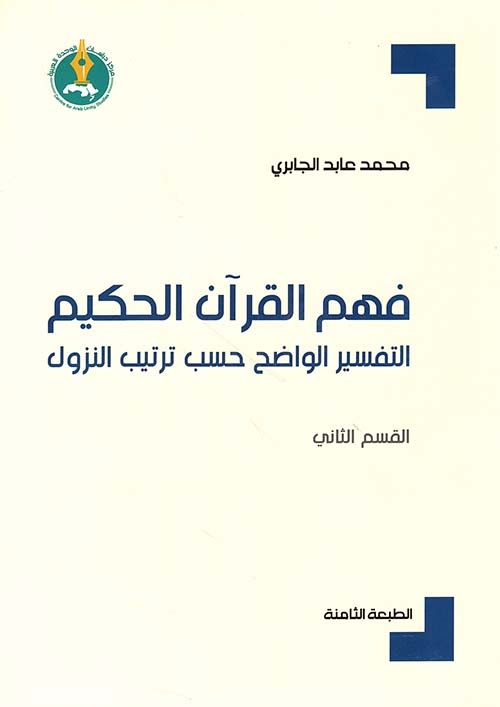
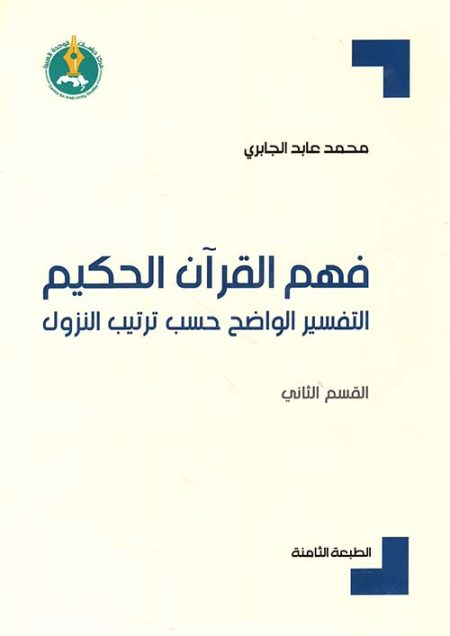
The Center for Arab Unity Studies has published “Understanding the Wise Qur’an: A Clear Interpretation According to the Order of Revelation, Part Two” by Dr. Mohammed Abed Al-Jabri.
In this book, the eminent Arab thinker Dr. Mohammed Abed Al-Jabri presents the second part of his project, “Writing Qur’anic Interpretation: Understanding the Wise Qur’an – A Clear Interpretation According to the Order of Revelation.” This three-part project reflects, in its entirety, the general and practical conclusion the author reached after examining existing commentaries: that the Arab-Islamic library lacks a commentary that draws upon all previous interpretations in the process of “understanding.”
To this end, the author constructs his Qur’anic interpretation based on the order of revelation, not only on the level of the “cosm and creation” narrative, which we might call the “path of revelation,” but also on the level of the Prophet Muhammad’s mission and biography. The author believes that the Holy Quran was revealed gradually over a period of more than twenty years, and that the sequence of its chapters—according to the order of revelation—is based on a logical sequence. Therefore, by examining the events of the Prophet’s life, he discovered that this underlying logic within the sequence of chapters, within each group, corresponds in substance to the sequence of these events. This clearly demonstrates that the course of revelation was indeed parallel to the course of the Prophet’s mission.
The author employs a method of explanation more closely aligned with contemporary writing practices, as the use of diacritical marks is essential for clarifying this project of interpretation.
The second section comprises thirty-eight (38) chapters, from Surah Al-Hijr to Surah Al-Hajj (according to Al-Jabiri’s arrangement). In it, he highlights three stages: (1) the public declaration of the message and communication with the tribes, (2) the siege of the Prophet (peace be upon him) and his family in the valley of Abu Talib, and the Muslims’ migration to Abyssinia, and (3) the period after the siege: continued communication with the tribes and preparations for the migration to Medina.
It is a noble project, in which the author feels a profound sense of accomplishment in his endeavor: to read the Holy Quran through the lens of the Prophet’s biography, and to read the biography through the lens of the Quran. This dual approach has enabled him to recognize the intimate relationship between the Prophet Muhammad (peace be upon him) and the Wise Quran.
Reviews
There are no reviews yet.