
Description
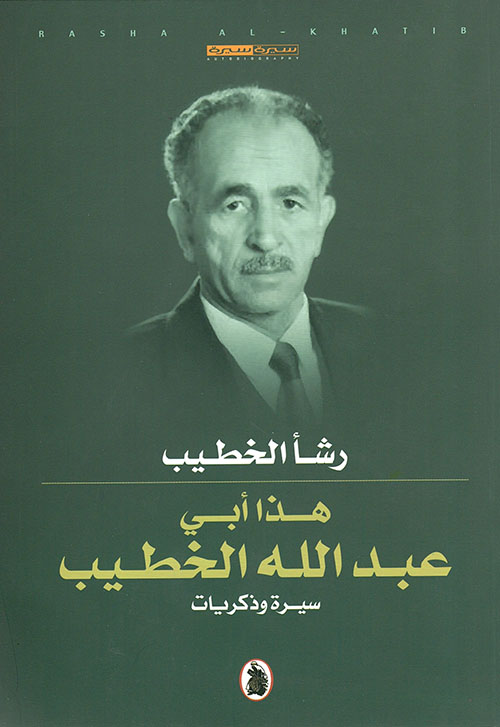
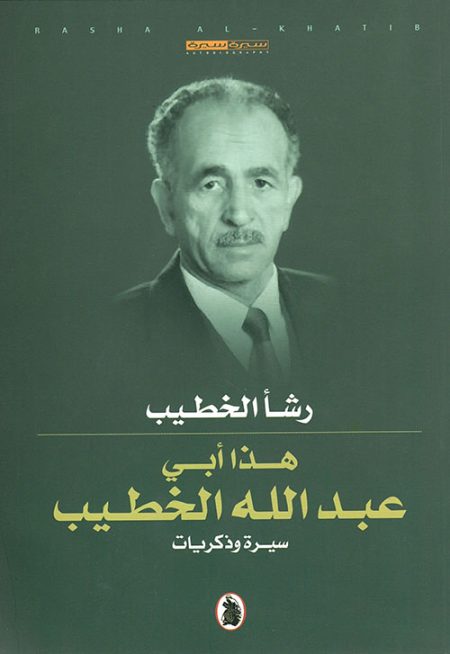
The biography written by Rasha Al-Khatib about her father—titled *This Is My Father, Abdullah Al-Khatib: A Biography and Reminiscences*—is not the life story of a famous or highly influential figure, as is often the case with conventional biographies. Rather, it is the story of an ordinary man who lived his life on this earth just as many others have—known only to his family, friends, acquaintances, and neighbors; those whose paths crossed with his through ties of kinship, friendship, proximity, or companionship.
The significance of this work—recently published by the Arab Institute for Research and Publishing (2020)—lies in the value of self-reflection. It may lead younger readers to realize that every life story is truly worth telling, allowing it to become part of the lives and future moments of others; for each of us has a story to share.
In this text—which functions simultaneously as a biography and a collection of memories—we encounter the stories that shaped the life of Abdullah Al-Khatib, a man from northern Jordan. By also touching upon the lives of his father and grandfather, the narrative offers a glimpse into the realities of life in Jordan from the beginning of the twentieth century through the start of the next. The narrative begins with the life story of the author’s great-grandfather, Sheikh Muhammad bin Al-Sayyid Al-Masri. In the late nineteenth century, he left his native Egypt and traveled across the lands of Greater Syria—a region then unconstrained by borders. He spent time in Palestine, serving as a preacher and teacher in villages near Jerusalem, where he married and had his first children. By the mid-twentieth century, he set off once more, moving to Transjordan, where he settled in the Ajloun District—specifically in the Al-Koura region.
Through these accounts, the author touches upon the simple, everyday details of a typical Jordanian family—their traditions and their persistent quest for a livelihood that would sustain them and ensure a dignified life. Despite the hardships they faced, their lives remained rich in generosity. At the same time, the narrative sheds light on certain negative social phenomena—particularly those affecting young women—and reveals the prevailing societal attitudes toward education, religion, and social conduct.
This account reflects a life shared by many in the region: a journey marked by migration, hardship, and the arduous process of self-building. It is a story of resilience—of individuals striving for personal growth while securing the basic necessities of life. The narrative continues by tracing the life of Abdullah Al-Khatib, who moved from his village to Irbid, and later, in his early youth, to the capital, Amman, in search of work and a living. It follows how he built his life, step by step, eventually securing a position at the Amman Civil Airport and establishing his own small family. Abdullah Al-Khatib entered university ten years after finishing school—a delay caused by several factors, including the absence of universities in Jordan in the late 1950s and a lack of the financial means required to pursue studies in Damascus, Beirut, or Cairo. Yet, when the opportunity finally arose, he did not hesitate. He chose to study history, enrolling as an external student at the Arab University of Beirut. In the process, he fell in love with Beirut—a city that never left his heart. He had hoped to pursue postgraduate studies, but the outbreak of the Lebanese Civil War in the mid-1970s made that impossible.
Through this narrative, the reader gains insight into the details of daily life during the 1960s and 1970s—a time of travel across the Levant, with memorable visits between Jordan, Syria, Lebanon, Palestine, and Egypt. Though these visits were often brief, our protagonist chose to live life to the fullest, embracing every moment as if he were the lead character in his own personal film.
After concluding the biography of her father, Abdullah Al-Khatib, the author presents further records written in his own hand: his reflections on the Hajj pilgrimage he undertook in 2006, as well as letters he sent to his daughter, Rasha, while she and her family were living in Britain between 2000 and 2002. These documents offer a glimpse into his life, his relationships with his children and grandchildren, and the principles he held regarding child-rearing—revealing the care, attention, and deep affection he consistently showed toward his family.
Beyond his own writings, the author invites us to view aspects of his life through the eyes of others. Through the pens and eyes of his grandchildren, and the words of his children, this biography finds its conclusion—a portrait completed by glimpses into various milestones of his life.
This commemorative text serves as an extended reflection on the life of an “ordinary” man—a man who nonetheless touched the lives of others through his very presence and his unassuming nature. His life forms a piece of the larger mosaic of an era that still resonates today; it is the story of a father, a grandfather, a companion, and a neighbor—a man who held significance for everyone who knew him. After all, each of us possesses stories worth telling—stories that deserve to be shared.


Reviews
There are no reviews yet.