
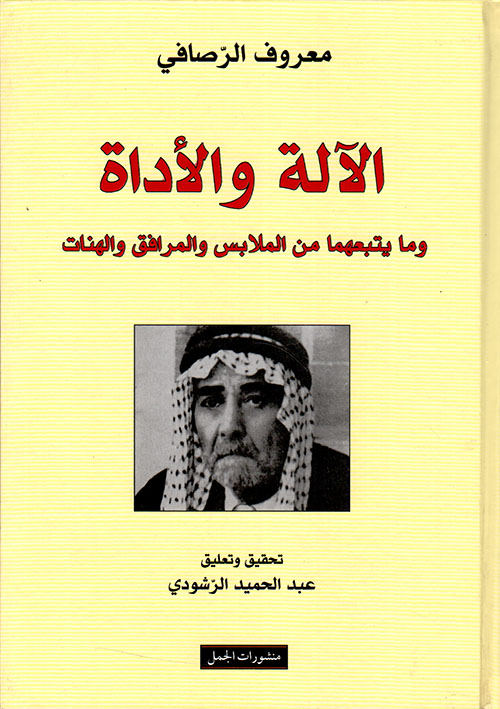
Description
This book, “The Machine and the Tool,” is considered al-Rusafi’s most important work in the field of linguistics. In it, he compiled a vast collection of names for machines, tools, and related clothing, accessories, and items needed by civilized society and necessitated by the modern city. His method for this was to consult major dictionaries, both old and new, although it is noticeable that he drew heavily from the work of the Lebanese scholar, Sa’id al-Shartuni.
He arranged the words he encountered alphabetically, based on their first letter, whether root or affixed. Al-Rusafi did not adopt a rigid, verbatim approach in this book; rather, he interweaved his opinions and linguistic philosophy, which advocated for greater flexibility in naming conventions due to the demands of modern civilization. Therefore, he opposed Ibn Faris’s rigid and dogmatic view, who declared, “We are not permitted to invent anything today, nor to say anything different from what they said, nor to make analogies they did not make.” Al-Rusafi’s approach to analogy is closer to that of Ibn Jinni, who stated, “Whatever is measured against the speech of the Arabs is considered part of the speech of the Arabs.” Al-Rusafi saw no harm in including some colloquial terms in his book. Treating colloquial words alongside classical Arabic is not unprecedented in lexicography; Sayyid Murtada al-Zabidi followed this approach in his Taj al-‘Arus, adding a number of Egyptian colloquial terms to his dictionary.
Given the importance of the book, it has been meticulously edited and verified. The version adopted is the author’s only copy, which he completed in its final draft on the 9th of Rabi’ al-Thani, 1337 AH/1918 CE in Constantinople. It is written in the author’s beautiful Naskh script and contains some blank pages, as well as missing pages, which the editor has indicated in their respective places within the book, placing the missing words he could locate in brackets.
The author wrote these pages in his teachers’ notebooks, which occupied seven volumes. The editor has added marginal notes that he deemed necessary and included some poetic examples. Furthermore, al-Rusafi, in his wisdom, recognized the nation’s need for such a book at an early stage, understanding the needs of the era and the demands of civilization and development. He believed that the growth of the language could only be achieved by reopening the door of linguistic inquiry, which had been closed by stagnation and backwardness, preventing the language from keeping pace with cultural trends. The ever-evolving and diverse needs of humankind.


Reviews
There are no reviews yet.