
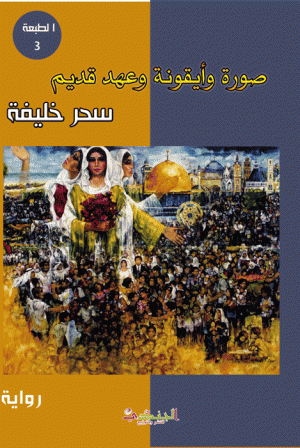
Description
This is a narrative about the fate of Jerusalem, the holy city that Arabs will not “relinquish,” the revered city that Muslims will not “give up,” and which, despite “grand and resounding intentions,” is being Judaized day by day, bit by bit, by the intransigent Zionists, as if it were bleeding its “Arabness” and “Islam” identity, moving towards Judaization and Israeli control. This is despite a glorious, solitary, honorable, and ultimately betrayed Palestinian struggle, which was once drowned in “blessed prayers” until the era of “international terrorism” arrived after the infamous September 11th attacks, forcing an economy of prayer and a rationing of words.
This is a narrative about Arab Jerusalem, nearing its end. A story within a story, and a story within stories, reflections, symbols, and fading memories. It tells what it has seen and sees what it does not wish to say fully, leaving the reader to fill in the gaps and complete the missing lines. Perhaps this statement, which is simultaneously clear, ambiguous, and lacking in clarity, is what allows the novel to generate its intended meaning from multiple layers, beginning with a stifled love and ending with a lost holy city.
The novel begins, on its first level, with an “impossible” love between a man and a woman belonging to different religions. While love is a human right, the lover’s misery, his vulnerability, and his fragility transform love into a sin, as if the beautiful and radiant one is destined to fall into his anticipated tragedy. However, contemplating Sahar Khalifa’s text, in its explicit and implicit language, and in its symbols and allusions, deepens and intensifies the preceding meaning. The story departs from its familiar, everyday meaning—which speaks of a backward consciousness, the power of habit, and Zionist oppression—and evokes another, broader, and more ambiguous meaning: that of “Abraham,” a name associated with prophets, and “Mary,” a name linked to a holy woman who conceived without intercourse and gave birth to a prophet.



Reviews
There are no reviews yet.